In short: after buying a used car, pay for diagnosis and required maintenance first, then order accessories for confirmed needs. The first wave usually includes vehicle-specific cabin and boot mats if the original protection is missing or worn. Buy a bulb only after checking the relevant lamp unit, choose a phone mount and charger after inspecting the dashboard, socket and phone, and select an organiser after measuring usable boot space. A VIN starts the search, but it does not replace checks of the generation, facelift, body style, specification and parts that previous owners may have changed.
Why order matters especially with a used car
Ukraine’s domestic used-car market is not a small side segment. In May 2026, the Institute for Car Market Research recorded 78,455 domestic resales out of 105,593 passenger-car market operations that month — roughly 74%. The average passenger car sold on the domestic secondary market in June was 15.9 years old. The Main Service Centre of the Ministry of Internal Affairs separately reported 2,195,320 registration actions across all vehicle types in 2025. These are different measures, but together they explain the practical setting: owners often equip an older car whose lamps, interior, wiring, boot floor or mounting points may no longer match its original factory configuration.
A catalogue filtered by make and year is therefore a shortlist, not a final answer. In addition to the registration certificate, check the model year, generation and facelift, body style, left- or right-hand drive, engine or hybrid version, number of seats and actual specification. If a former owner replaced something, compatibility must be based on the fitted part and installation point.
Important: accessories do not replace checks of the brakes, steering, tyres, battery, fluids and standard lighting. If an inspection finds a fault, put the budget towards repairing it before comfort upgrades.
Build a compatibility record in 20 minutes
Before browsing products, create one note on your phone. Record the make, model, VIN, build year and model year, body style, generation/facelift, steering position, powertrain and number of seating rows. Add a photo of the registration certificate without sharing personal details, an overall photo of the car and close-ups of each relevant area.
- For the cabin: each footwell, the driver’s pedals, footrest and type of factory mat retainers.
- For the boot: its outline, adjustable floor, side recesses, subwoofer, spare wheel and third row in both positions.
- For lighting: the failed bulb’s function, markings on the old bulb and lamp unit, connector, rear cap and free space inside the housing.
- For electronics: the 12/24 V socket, its depth and condition, USB-port positions, vent shape and dashboard material.
- For the phone: dimensions and weight with the case fitted, preferred orientation and cable connector.
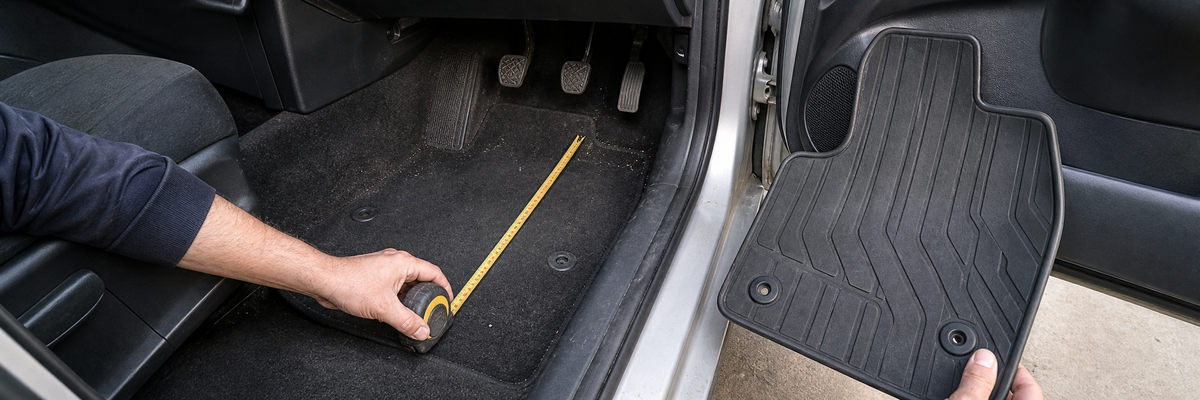
Photos and measurements of the actual installation area answer more questions than the model name in an advert.
Comparison table: what to order first and what can wait
| Category | When it is a first priority | What to confirm before paying | When to wait |
|---|---|---|---|
| Vehicle-specific cabin mats | Mats are missing, or the driver’s mat is damaged, slides or leaves the carpet exposed | Generation, body style, steering position, floor shape, retainers and full pedal travel | If the floor version is uncertain or the set needs trimming near the pedals |
| Vehicle-specific boot mat | You regularly carry shopping, a pushchair, tools, wet items or dirty loads | Body style, model year, adjustable floor, recesses, subwoofer, five/seven seats and lip height | Until the floor layout and spare-wheel access are clear |
| Car bulb | A particular standard bulb has failed or diagnosis confirms that it needs replacement | Function, lamp-unit type, base, voltage, connector, dimensions, electronics and manufacturer requirements | If poor output may come from the lamp unit, wiring, voltage or alignment |
| Phone mount | You need navigation and currently leave the phone in an unsafe place | Size with case, weight, mounting surface, view, controls and airbag deployment zones | If it can only grip a fragile vent or would block the road view |
| Car charger | There is no factory USB port or it cannot supply what the device needs | 12/24 V, socket condition, phone protocol, output per port and cable capability | If the socket is loose, becomes hot or the car’s power supply has not been checked |
| Organiser or net | Small items move around the boot and obstruct everyday cargo | Size, attachment method, factory tie-downs, contents weight and floor access | Until you know the regular load and genuinely free boot volume |
First protection: fitted cabin and boot mats
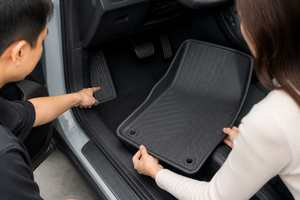
Begin with what the previous owner left behind. A universal driver’s mat, curled edge, missing retainer or two mats stacked together is a reason to remove the unsuitable part, not to “upgrade” the pile. The driver’s footwell needs one mat that follows the floor, attaches as intended and stays well clear of every pedal.
When comparing cabin and boot mats, look beyond the material. Ask for a set diagram and a photo of the driver’s piece showing the footrest, centre tunnel, raised edges and retainer positions. After fitting, with the vehicle stationary and the engine switched off, press each pedal through its full travel and confirm that the mat does not move.
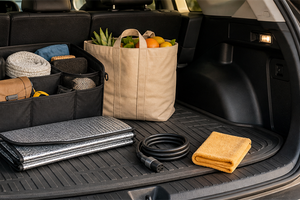
For the boot, “fits this model” is not enough. One nameplate may cover a saloon, hatchback or estate, a fixed or adjustable floor, five or seven seats, a subwoofer or hybrid components beneath the floor. Compare the outline, lip height, recess and spare-wheel access. If the seller cannot confirm the layout, send photos and measurements or postpone the order.
Car bulbs: a matching base does not prove compatibility
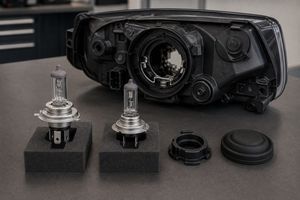
First identify the job: dipped or main beam, fog lamp, position lamp, indicator, brake light, number-plate lamp or interior light. Remove and photograph the old bulb and the markings on the lamp unit. In the car-lighting section, check the function, base, voltage, connector shape, polarity, body length, rear cap and room for cooling.
For an LED option, also consider the lamp-unit design, light-source position, adapter, dust cover and vehicle electronics; flicker or a dashboard warning may occur. Ukrainian traffic rules require the bulb type to correspond to the lighting device and the exterior lighting to remain consistent with the vehicle’s design. A shared H4 or H7 marking alone therefore cannot establish that a retrofit is suitable. If the evidence is incomplete, restoring the standard bulb type and having the aim checked by a specialist is the safer decision.
If both headlamps are weak, the cause may be a cloudy lens, damaged reflector, poor connection, voltage drop or bad alignment. Buying a “brighter” bulb without diagnosis will not repair those faults.
Phone mount and charger: choose them as one system
Test a phone mount against the phone with its case. It must support the combined weight on rough roads, avoid blocking the road, instruments and controls, stay outside airbag covers and avoid forcing the driver to reach. In an older car, vent slats may be brittle and a textured dashboard may not hold a suction cup or adhesive pad. Choose the real mounting point and measure the cable route before ordering.
For a car charger or USB adapter, establish the socket voltage, depth and whether power switches off with the ignition. Match the phone’s supported charging protocol, connector, individual-port output and cable capability. The total figure printed on a multiport adapter does not mean that every port can deliver the same output.
After the first installation, check that the adapter does not work loose, obstruct a lever, lid or cupholder, and that the cable is not under tension. Strong heat, smell, sparking or intermittent contact is a reason to stop using it and have the socket and device checked, not to push the adapter in harder.
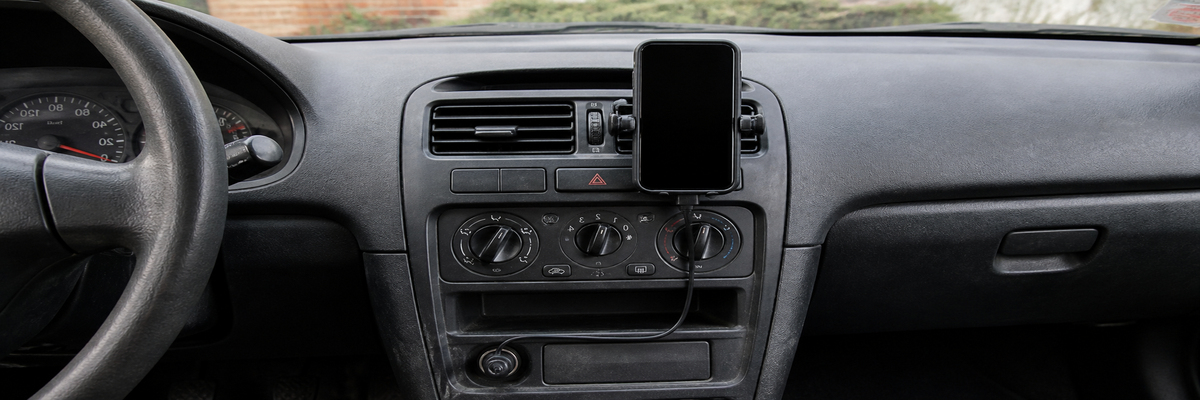
The mount leaves the view and controls clear, while the short cable stays by the centre console instead of reaching towards the steering wheel or pedals.
Organiser: define the load before choosing the format
Do not buy the largest box simply because the boot appears spacious. List the items that stay in the car: a pump, cable, wipes, shopping or children’s supplies. Then measure the free area while allowing for a pushchair, spare wheel, parcel shelf and folded seats. Among car bags, nets and organisers, choose the format for that use: a collapsible box for small items, a net for light objects or a bag that is easy to carry.
Check the base, dividers, handles and attachment method. Hook-and-loop material may not grip a smooth plastic floor, while an unsecured box moves under braking. An organiser creates order but does not replace factory tie-downs, a net or straps for heavy cargo, and it must not block the latch, emergency access or spare wheel.
Compatibility before ordering: questions for the seller
- Which generation and model years is the part made for? Ask for a year range and facelift detail, not just the model name.
- Which versions differ? Body style, steering position, hybrid system, all-wheel drive, seat count, adjustable floor and audio system may change the geometry.
- Exactly what is included? The number of mats, fasteners, adapters, cable and spare pieces should be stated.
- What are the dimensions and mounting points? Compare them with your own photos and measurements, not an image of a similar cabin.
- What limits does the manufacturer state? Voltage, lamp-unit type, phone weight, surface material and total load matter more than the word “universal”.
- Can the item be checked without leaving installation marks? Compare the shape, connectors and position before removing film or bonding a pad.
Mistakes after buying a used car
- Ordering the whole accessory bundle on purchase day, before diagnosis and a fault list.
- Treating the first-registration year as the exact model year and missing a generation change or facelift.
- Relying only on the VIN although lamps, seats, dashboard or boot floor may have been replaced.
- Buying a mat from its outline in a photo without checking retainers and the pedal area.
- Choosing an LED bulb solely by its base and a brightness claim.
- Mounting a phone holder on a brittle vent or in the field of view, then routing the cable across the steering wheel or gear lever.
- Expecting maximum charging power without a compatible phone and cable.
- Filling an organiser with heavy items and leaving it unsecured.
Checklist for a sensible first order
- Complete the diagnosis and separate faults from comfort needs.
- Create the vehicle record and photograph the actual installation areas.
- Make three lists: “needed now”, “after checking” and “can wait”.
- Send the VIN to the seller only with the generation, body style, specification, photos and measurements.
- Confirm the set contents, dimensions, mountings, voltage and manufacturer restrictions.
- On delivery, compare the product with the car before any irreversible installation.
- Install one accessory at a time and check pedals, view, controls, heat, retention and boot access.
- Keep the packaging, markings and order details until the checks are complete.
FAQ
Can every accessory be selected from the VIN alone?
No. The VIN helps identify the original specification, but it does not show every change made by former owners. Add the model year, body style, facelift, specification, photos and measurements of the actual installation point.
Is the year on the registration certificate enough for fitted mats?
Not always. The first-registration year can differ from the model year, and pre- and post-facelift cars may share a calendar year. Confirm the generation, body style, steering position, floor shape and factory retainers.
Can any H7 LED replace an H7 halogen bulb?
No. A matching base does not confirm the lamp-unit type, fit, dimensions, cooling, light-source position, electronics or suitability of the change. Check the lamp markings, handbook and manufacturer requirements; ask a specialist when evidence is incomplete.
What should I buy first on a limited budget?
After diagnosis, address an everyday risk: an unsuitable driver’s mat, an unprotected boot or a failed standard bulb. A mount and charger come next if routes genuinely require them; choose the organiser after a week of real use.
Will a universal mount or charger suit an older car?
Not necessarily. A mount depends on the phone’s weight, case, vent or dashboard surface and safe installation zone. A charger depends on socket voltage, depth and condition, the device protocol, port output and cable.
Should I buy an organiser together with the boot mat?
Only if the load and free space are already clear. Fit or measure the mat first, confirm access to recesses and the spare wheel, then choose an organiser that can be secured without obstructing normal loading.