Short answer: use a rain repellent on the outside of the windscreen and side windows only when the manufacturer expressly permits use on automotive glass. Use a separate anti-fog product on the inside. For exterior door mirrors, choose either an approved treatment or a transparent protective film, but check its intended surface, shape and size first. No treatment replaces working wipers, washers or cabin ventilation.
Why one bottle is rarely the complete answer
In Ukraine, a late-summer or early-autumn journey can begin on a warm dry afternoon, continue through a heavy shower and end in a cool evening. Outside, visibility is reduced by water, traffic film, dust and insect residue. Inside, the glass fogs when humid cabin air meets a colder surface. These are different problems with different causes.
A rain repellent creates a water-repellent layer on the exterior glass. An anti-fog product leaves a thin layer on the interior surface that helps condensation avoid forming opaque droplets. Start with the question is the problem outside or inside? rather than with a brand name. In the rain repellent and anti-fog category, compare the stated use, approved surfaces and application method of each product.
Ukraine's Patrol Police advises drivers that rain reduces visibility and that the windscreen, wiper blades and ventilation all need attention. The Ukrainian traffic rules also require the windscreen wipers and washers provided by the vehicle's design to work. A hydrophobic coating is supplementary care, not an “invisible replacement” for those systems.
Selection table: surface, problem and suitable solution
| Surface and scenario | What blocks the view | What to choose | What to check before use |
|---|---|---|---|
| Outside of the windscreen | Rain, traffic film and water marks | Rain repellent approved for exterior automotive glass | Preparation, application temperature, waiting time and wiper compatibility |
| Inside of the windscreen | Condensation and a humid film | Interior anti-fog treatment | Approved materials, buffing method and absence of haze |
| Outside of a side window | Droplets and dirty runs | Exterior rain repellent if the instructions list this surface | Tint film, seals, curing time and water exposure |
| Exterior door mirror | Droplets that distort the reflection | Mirror-compatible treatment or transparent film | Size, shape, optical clarity, heating and fitting method |
| Glass with grease or mineral deposits | Smears, glare and white marks | General glass cleaner or a specialist product for the deposit | Compatibility with tint film, plastics and factory coatings |
| Routine cleaning on the road | Dust, insects and dirty spray | Seasonal washer fluid and serviceable blades | Temperature range, concentrate dilution, jets and blade rubber |
Outside of the windscreen: when rain repellent helps
Apply rain repellent to clean exterior glass after normal washing has removed grit and road dirt. If greasy film, hard-water deposits or an old coating remain, the new layer may bond unevenly. The result can be glare, lines in the swept area or wiper judder. Identify the contamination first, use an approved cleaner and only then apply the coating.
Do not assume that every product follows one universal method. Some require degreasing; others require only clean, dry glass. Application temperature, number of layers, waiting time before buffing and the water-free curing period can all differ. Take these values from the specific label. Do not work on hot glass, in direct sun or in rain unless the instructions expressly allow it.
Inspect the blades before treating the glass. Grit, a damaged edge or hardened rubber will smear water regardless of the coating. Once the product has fully cured, inspect the windscreen from several angles and under side lighting. If haze remains, remove the residue using the manufacturer's method before driving.
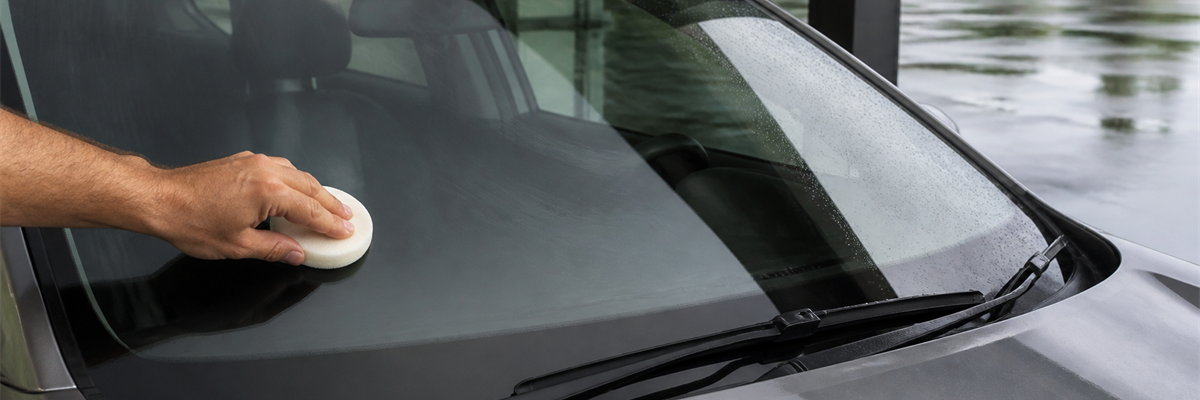
Apply the product only to a properly prepared surface and observe its waiting time: a thin, even layer is easier to buff without streaks.
Interior glass: anti-fog treatment does not remove cabin moisture
Apply anti-fog treatment to a clean, dry interior surface. A practical sequence is to ventilate the car, clean the glass with a dedicated microfibre cloth, dry it completely, transfer the product to a clean cloth or applicator, spread it evenly and buff it after the stated waiting time. Spraying a large amount directly above the dashboard is usually a poor method because droplets can reach a display, plastic trim or fabric.
The treatment can reduce visible fogging but does not remove the moisture source. If condensation returns quickly, check wet mats and clothing, the blower and air conditioning, the cabin filter, recirculation mode and possible leaks. To recover visibility quickly, use the vehicle's demist and air-conditioning controls as described in its handbook; do not wipe the glass by hand while moving.
Do not apply the product to displays, instrument plastics, camera lenses, sensor housings, electrochromic mirrors or tint film without express approval. A bottle marked “for glass” is not necessarily compatible with every transparent or coated surface.
Door mirrors: treatment or protective film
There are two routes for an exterior mirror. The first is a treatment whose instructions specifically include mirrors. The second is a ready-made transparent film. Before ordering protective film for exterior mirrors, measure the usable mirror area, account for its curvature and choose a shape that remains entirely on the glass without covering the edge of the field of view.
Check the package description for the number of pieces, actual dimensions, wet or dry fitting method, suitability for heated mirrors and the waiting time before rain exposure. Do not assume anti-glare or anti-icing performance unless the selected film's instructions confirm it. The priorities are clear optics, an even fit and no trapped bubbles.
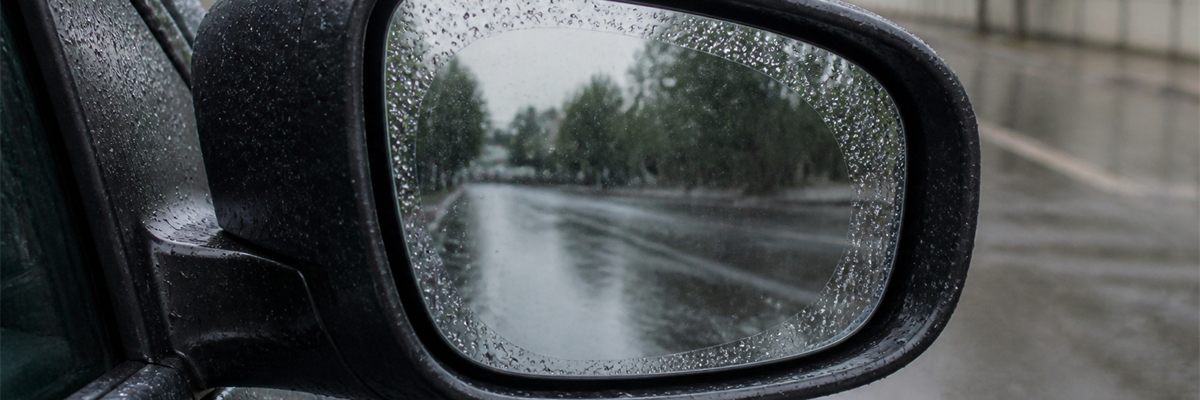
The film must fit wholly on the mirror element, preserve an undistorted reflection and contain no bubbles; confirm heated-mirror compatibility in the instructions.
Glass cleaner and washer fluid perform different jobs
Automotive glass cleaners are used for preparation and local cleaning. A general formula tackles dust and greasy film, an insect remover targets organic residue, and an abrasive or acidic mineral-deposit cleaner demands particularly careful surface checks. Do not use an aggressive product on tint film, plastic, a mirror coating or near rubber seals without confirmed compatibility.
Seasonal windscreen washer fluid works during a journey through the jets and wipers. At the end of summer, traffic film and insect removal matter; before cooler weather, the approved temperature range matters as well. Dilute a concentrate only at the stated ratio. Do not mix unknown residues, and do not treat washer fluid with a rain-repellent claim as an automatic substitute for a prepared coating: the formats and application conditions differ.
Compatibility checks before ordering
- Side of the glass: exterior for rain repellent and interior for anti-fog unless the label explicitly says otherwise.
- Material: ordinary glass, mirror glass, tint film, plastic and electrochromic surfaces need separate approval.
- Application zone: check the windscreen, side windows, mirrors and lamp lenses separately; permission for one does not cover all.
- Surface condition: chips, cracks, mineral deposits, old coatings and deep scratches may need diagnosis or specialist preparation first.
- Application conditions: surface temperature, shade, dryness, waiting time before buffing and water-free curing come from the instructions.
- Wipers and washer: inspect blade edges, jets, fluid level and seasonal rating before applying a coating.
- Mirror film: check width, height, shape, curvature, quantity and suitability for a heated mirror.
- Package and safety: confirm volume, applicator or cloth, expiry date, storage conditions and label warnings.
Mistakes that can make visibility worse
- Applying exterior rain repellent inside and expecting it to solve condensation.
- Coating dirty, wet or hot glass and buffing with the same contaminated cloth.
- Treating anti-fog product as a repair for poor ventilation or a cure for persistent cabin damp.
- Using a product on tint film, a screen, instrument panel or electrochromic mirror without approval.
- Fitting film of the wrong size, leaving bubbles or continuing to use it when the reflection is distorted.
- Ignoring streaks, noise or wiper judder after application. Restore clear glass by following the product instructions before driving.
- Mixing concentrates and remaining washer fluids of unknown compatibility.
- Relying on a coating when the blades, washer jets or demist system do not work.
Checklist before heavy showers and cool mornings
- Inspect the glass for chips, cracks, greasy film and mineral spots.
- Wet the windscreen and check that the blades clear without gaps and the jets reach the swept area.
- Check ventilation, air conditioning, the cabin filter and any wet material inside the car.
- Keep separate microfibre cloths for exterior and interior glass.
- Choose a product for each specific surface and read the label before opening it.
- Test a small approved area when the instructions recommend it.
- After buffing, look through the glass in daylight and under angled artificial light.
- Test the wipers only on wet glass after the coating has fully cured.
- Do not drive while haze, streaks, bubbles or optical distortion remain on the glass or mirror.
FAQ
Can one product treat the glass both outside and inside?
Only if the manufacturer expressly lists both surfaces and provides instructions for each. In the usual case, rain repellent belongs outside and anti-fog treatment belongs inside. Do not infer compatibility from the product name alone.
Which is better for door mirrors: rain repellent or film?
A treatment is convenient when it is approved for mirrors and you are prepared to renew it as instructed. Film avoids buffing, but it must match the size and shape, preserve the reflection and suit a heated mirror. The better choice depends on the actual mirror and product.
Why do the wipers streak or judder after rain repellent is applied?
Common causes include poorly cleaned glass, excess product, incorrect curing, residue from an old coating or worn blades. Do not continue with hazy glass. Clean it by the manufacturer's method, inspect the blade rubber and reapply only after finding the cause.
Will anti-fog treatment solve persistent damp inside the car?
No. It helps the surface remain clear, but the moisture stays in the cabin. Dry wet items and mats, and check the ventilation, filter, air conditioning, recirculation setting and possible leaks.
Does rain-repellent washer fluid replace a separate coating?
Not necessarily. Washer fluid touches the glass briefly and works with the blades, while a separate coating requires preparation and curing. Compare the stated purpose, application method and limitations of the actual products.
Can these products be used on tinted glass or clear plastic?
Only with explicit compatibility. Tint film, instrument plastics, displays and lenses can react differently from ordinary glass. Choose a specialised cleaner or treatment when approval is absent.