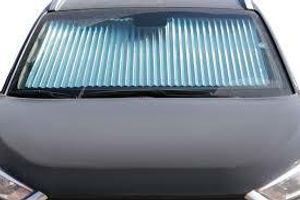
Short answer: do not choose a car cover from the S, M or L label alone, and do not rely on vehicle length alone. Identify the body style and roofline first, then compare the car’s measurements with the chart for the exact cover: length, width, height and, where the maker requires it, circumference at bumper level. A suitable cover reaches around the lower parts of both bumpers without being stretched over mirrors or a spoiler and without leaving large folds that flap in the wind. For outdoor parking, also check that the product is intended for exterior use, can release water vapour, has a body-safe inner surface and includes a proper fastening system.
What an outdoor cover can do — and what it cannot promise
A car parked outside in Ukraine is exposed to direct sun, road dust, pollen, bird and tree residue, rain, wet snow and ice. A suitable outdoor cover reduces direct contact with these contaminants and can make the vehicle easier to prepare after a long pause. Performance is product-specific, however. The words “polyester”, “PEVA” or “membrane” do not by themselves prove water resistance, UV protection or moisture release.
A soft cover is not a garage or a rigid shelter. It cannot guarantee protection from branches, flooding, severe hail or every storm-force gust. The Ukrainian Hydrometeorological Center notes that warm-season thunderstorms can bring intense precipitation, hail and strong wind gusts. When dangerous weather is forecast, safer parking matters more than an “anti-hail” label, and the cover’s tension and fasteners should be checked beforehand.
Choose the body shape before the size
Two vehicles with the same overall length may have different rooflines, heights and rear overhangs. Start with car covers for sedans for a three-box body, covers for SUVs and minivans for taller vehicles, or covers for estates and hatchbacks for a roofline ending at a rear door. The category gives you the basic pattern, but measurements still decide the fit.
A sedan or saloon has a separate boot projection; a cover with a short rear section will pull across the boot lid and may not hook under the bumper. A hatchback is shorter and has a steeper rear door, so a similarly long sedan cover can leave a loose pocket at the back. An estate or station wagon also has a fifth door but a longer roof and load area. An SUV or crossover is taller and wider, while a minivan can have an even more upright, box-like profile. Roof rails, an aerial, a spoiler, an exterior spare wheel or a roof box all change the usable outline.
Letter sizes are not transferable between product ranges. In the ShopForCars catalogue, covers marked L for sedans have different numerical dimensions in different ranges. That is expected: manufacturers use different patterns and allowances. The dependable comparison is the numerical chart and fitting diagram for the exact item being ordered.
How to measure the vehicle before ordering
- Park on level ground. Close the doors, bonnet and boot. Decide whether the mirrors will be folded and whether a removable aerial or roof box will be taken off; measure the configuration in which the cover will actually be used.
- Measure full length. Use the distance between the furthest points of the front and rear bumpers, not the wheelbase shown in the registration documents.
- Confirm how width is defined. One chart may quote body width without mirrors, while another pattern may include mirror pockets. Do not add the mirrors automatically; follow the maker’s diagram.
- Measure height to the highest permanent point. Include factory rails or a fixed aerial only if the instructions allow them to remain under the cover. Do not stretch fabric over a sharp projection.
- Check any extra measurement. Some manufacturers use vehicle circumference at bumper height as the final control. If the product page lists it, measure it in the stated way.
- Record special features. An unusual spoiler or mirror shape, a rear-mounted spare, a tow bar or body kit can require another pattern even when length matches.
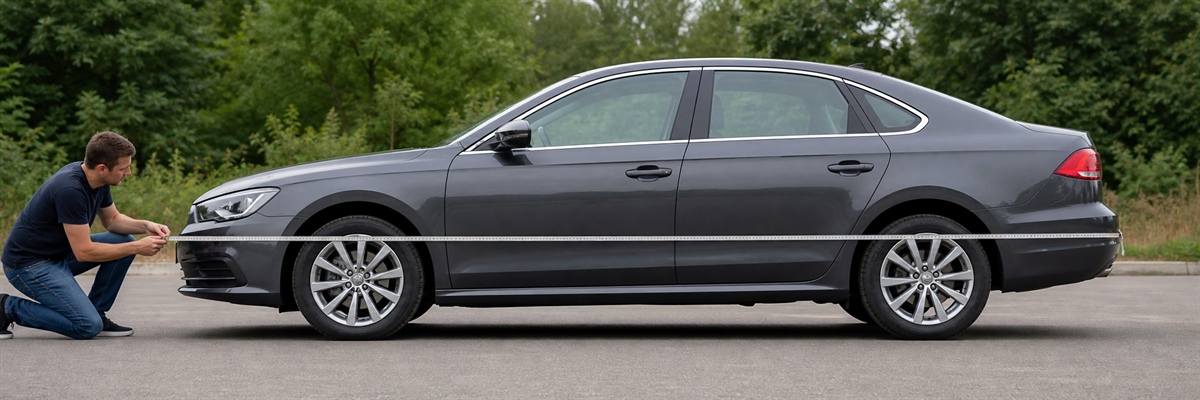
Measure the real vehicle in its intended covered configuration and compare the result with the exact manufacturer’s fitting diagram.
Body-style selection table
| Body style | Shape-defining feature | Main mismatch risk | Check before ordering |
|---|---|---|---|
| Sedan / saloon | Separate boot and sloping rear window | A short rear panel will not wrap under the bumper; a generic cover may bridge over the boot | Overall length, roof height, rear overhang and the lower elastic position |
| Hatchback | Short rear overhang and steep fifth door | A sedan pattern leaves a loose pocket at the rear and moves more in the wind | Length, height, rear-door angle, spoiler and aerial position |
| Estate / station wagon | Long roof and extended load area | A hatchback size is too short even when width and height match | Roof and body length, rails, spoiler and fifth-door shape |
| SUV / crossover | Greater height, width and rear volume | Length appears correct but insufficient width or height prevents the hem reaching the bumpers | All three dimensions, rails, aerial, exterior spare and fastening points |
| Minivan | Tall roof, long cabin and upright sides | An SUV pattern pulls tight across corners or leaves the lower body exposed | Length, height, width, sliding-door tracks, rails and a dedicated van/minivan chart |
How to recognise a correct fit
Do not try to stretch a cover like packaging film: the intended allowance is already built into its pattern. With a correct fit, the front and rear markers face the right way, seams sit close to the body lines, mirror pockets align with the mirrors, and the lower hem wraps securely around both bumpers. The fabric should not rest on the ground, be trapped in a door or pull over a sharp corner.
An undersized cover is difficult to secure: the elastic rises, corners slip off and seams or projections carry excessive load. An oversized one forms folds and a sail that rubs across dusty paint. If the vehicle falls between two sizes, do not automatically buy the larger one. Compare the body shape, every numerical range and the maker’s control measurement, then ask the retailer to confirm the choice.
Use only the intended fasteners. Tighten the drawcord or straps according to the instructions and pull-test the knot. If additional loops are provided near the wheels, attach them only to approved points. Do not hook metal hardware onto painted panels or improvise a strap through the cabin. Before hazardous wind, inspect the hem, knots and fabric for damage once more.
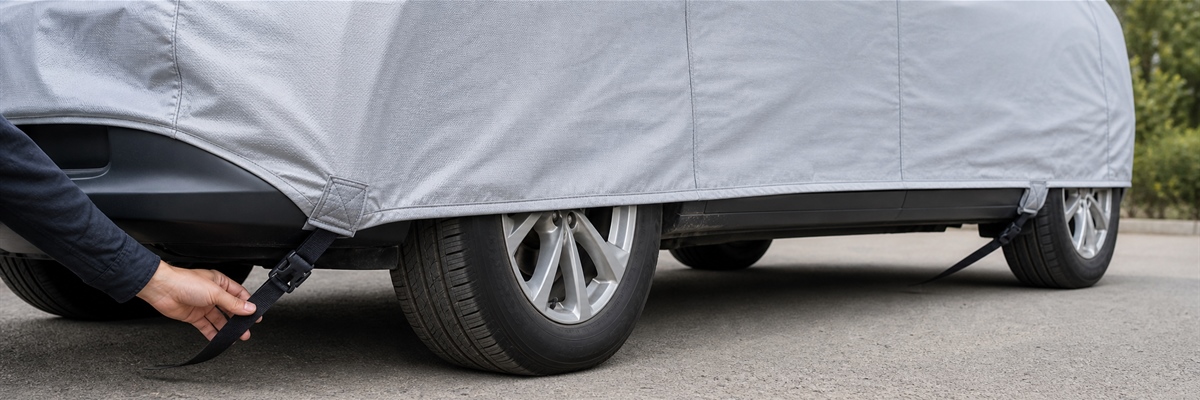
A good fit covers both bumpers, leaves very few loose folds and uses fasteners that hold the cover without harming painted parts.
Material and protection for outdoor parking
Instead of looking for a supposedly best fabric name, look for a confirmed set of properties. For long outdoor stops, the product should be approved for exterior use and should state its resistance to relevant precipitation and sunlight, ability to release water vapour, inner-surface design, seam construction and fastening method. Some covers add a soft lining, vents, mirror pockets or access to the driver’s door. These features help only when they match the vehicle and the intended use.
Water resistance and vapour permeability solve different problems. The outer construction needs to manage rainfall within its stated limits, while moisture in the air should not remain trapped against the paint for long periods. Even a vapour-permeable product is not permission to cover a wet car: the manufacturer’s official instructions call for a clean, dry vehicle.
“Anti-hail” describes a separate construction, not an unlimited guarantee. Check which areas are reinforced, what impact protection is claimed and which exclusions apply. When a severe thunderstorm is forecast, a sound canopy, covered car park or space away from trees and unsecured structures is safer than any soft cover.
Preparing a car for a long covered stop
- Wash the car, or at least remove all sand, dried mud and loose particles; movement of the fabric can turn them into an abrasive.
- Dry the body, gaps, mirrors and cover completely. Do not pack a damp cover in its storage bag.
- Let the vehicle cool after driving, especially the exhaust system. Keep fabric away from hot parts.
- Fold mirrors and deal with the aerial only as the cover and vehicle instructions specify. Remove an incompatible roof box or select a pattern designed for it.
- Find the front and rear labels, unfold the cover without dragging it on the ground, seat it around both bumpers and use the intended fastening system.
- After the first day and after strong rain or wind, check tension, moisture, inner-surface cleanliness and rubbing points. Repeat the inspection regularly during a long stop.
Compatibility: what to check before ordering
- Vehicle identity: make, model, year, generation and exact body style; one model name may cover a sedan, hatchback and estate.
- Numerical size: the car’s real length, width and height against the item’s stated range, without guessing from the letter code.
- Maker’s method: whether mirrors are included, whether bumper-level circumference is required and where the designed allowance should sit.
- Projections: rails, aerial, spoiler, exterior spare, roof box, body kit and any sharp edges.
- Intended use: explicit outdoor approval and product-specific claims for vapour permeability, UV resistance, water resistance or hail protection.
- Body contact: the inner surface must be clean, undamaged and suitable for the condition of the vehicle’s paintwork.
- Fastening: all drawcords, loops and straps are supplied, reach approved points and do not place hard edges against paint.
- Operating limits: the cover is for a parked vehicle; do not use it while driving or while transporting the vehicle on an open trailer.
Mistakes that reduce protection or damage the finish
- Ordering L or XL without comparing the numerical dimensions of that exact range.
- Treating a hatchback, estate and sedan as interchangeable because their lengths look similar.
- Buying a deliberately oversized cover “to be safe” and letting it flap over dusty paint.
- Stretching an undersized cover over mirrors, a spoiler, an aerial or a sharp accessory.
- Covering a dirty, wet or still-hot vehicle immediately after a journey.
- Assuming protection from the material name without checking exterior approval and instructions.
- Treating “anti-hail” as a promise against every hailstorm and ignoring official weather warnings.
- Leaving knots, elastic and the inner surface uninspected throughout a long parking period.
Ten-minute buying checklist
- Identify the exact body: sedan, hatchback, estate, SUV/crossover or minivan.
- Photograph the car from the side, front and rear, including rails, aerial and spoiler.
- Measure length, width and height using the selected range’s instructions.
- If bumper-level circumference is specified, measure that too.
- Compare every number and the illustrated shape, not just the size letter.
- Check exterior approval, moisture release, inner surface and stated limitations.
- Confirm that the supplied fasteners are complete and suit approved vehicle points.
- Test-fit the cover on clean, dry paint and inspect hems, seams and rubbing points before regular use.
Practical FAQ
What if the car’s length falls between two cover sizes?
Do not move to the larger size automatically. Compare the body shape, permitted length range, width, height and control circumference if listed. Choose the option whose hem reaches around both bumpers without strain while excess fabric does not form a sail. If uncertain, send the retailer your measurements and a clear side photograph.
Can I put the cover on immediately after rain?
No. Allow the body and its gaps to dry fully and make sure the cover’s inner surface is also dry and clean. Vapour permeability helps manage moisture during use, but it does not replace the manufacturer’s requirement to fit the product to a dry vehicle.
Will a standard cover fit an SUV with roof rails and a roof box?
Include the rails in the real height and confirm that the instructions permit that profile. A roof box changes the height sharply and creates stress points, so a standard SUV cover should not be stretched over it without explicit manufacturer approval. Removing the box or choosing a purpose-designed pattern is safer.
Can a car remain under a cover for several months?
Yes, but only with a suitable outdoor product, correct fit and regular checks. Both car and cover must be clean and dry. After rain or wind, inspect moisture, fasteners, rubbing points and the inner surface. A cover does not turn an open parking space into a maintenance-free garage.
Does an anti-hail cover guarantee that the body will not be damaged?
No universal guarantee exists. Read how the reinforced zones are built and the limitations stated for the exact item. Hailstone size, wind speed and storm duration vary; during an official warning, a robust shelter or covered car park remains the safer choice.